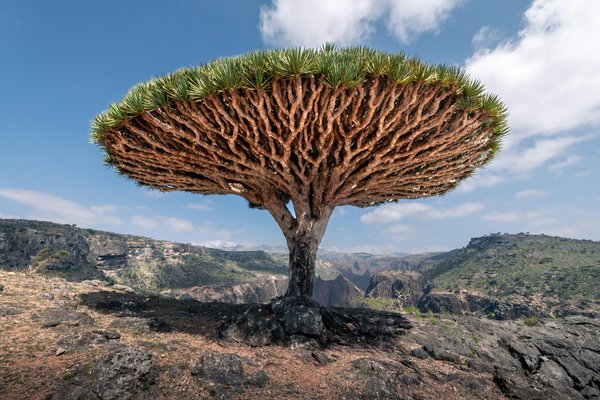
A Yemeni island 380 km south of Arabia with limestone caves holding ancient inscriptions, and 37% of plant species found nowhere else.
Socotra is a Yemeni island in the Indian Ocean, part of Socotra Archipelago Governorate, 380 kilometers south of Arabia. This UNESCO World Heritage Site has species found nowhere else, including Dragon's Blood Trees with umbrella-shaped crowns. You can explore limestone caves filled with ancient inscriptions. You can snorkel in marine protected areas, and can camp on beaches where dunes meet clear blue water.
Geography and environment
Socotra measures 132 kilometers long and 42 kilometers wide. The island has three distinct regions. Narrow coastal plains hold white sand dunes formed by monsoon winds. Limestone plateaus like Momi and Diksam show eroded rock surfaces. The central Hajhir Mountains rise to 1,503 meters.
Rainfall changes a lot across the island. Inland areas get up to 800 millimeters of rain each year during the northeast monsoon from October to December. The southwest monsoon from June to September brings strong winds and rough seas. Socotra separated from the ancient continent Gondwana during the Miocene epoch. This long isolation shaped its environment.
Unique plants
Thirty-seven percent of Socotra's 835 plant species live only here. The Dragon's Blood Tree (Dracaena cinnabari) produces red sap used in dyes and medicine. Its dense canopy helps condense moisture from the air. Bottle trees (Adenium obesum socotranum) store water in their thick trunks. They bloom with pink flowers.
Wildlife
Ninety percent of reptile species exist only on Socotra. Ninety-five percent of land snails are unique to the island. Genetic studies suggest scientists may find more undiscovered species. Areas like the Hajhir massif get more moisture. These wet zones support a high number of endemic species. These plants and animals developed in isolation over millions of years.
Key attractions and activities
Detwah Lagoon has a curved sandbar separating calm waters from the open ocean. This creates a good spot for marine life and photos. You reach Shoab Beach by boat from Qalansiyah. During the boat trip, you might see dolphins near the cliffs. At Firmhin Forest, you can camp under Dragon's Blood Trees. Their shapes stand out against the night sky. Explore Hoq Cave's 2-kilometer passage. Inside, you find Brahmi and Greek inscriptions left by sailors between 100 BC and 600 AD. Arher Beach has large white dunes next to good swimming spots. Dihamri Marine Protected Area lets you snorkel near coral reefs and sea turtles. Hike through Wadi Dirhur canyon on the Diksam Plateau. You see dramatic rock formations along the way.
Culture and local life
About 50,000 people live on the main island of Socotra. They speak Soqotri, a Semitic language different from Arabic. In mountain villages, women sometimes use red resin paste for traditional face painting. Annual poetry competitions celebrate a literary history going back to the 9th-century poet Fatima al-Suqutriyya. Hadibo, the capital, has an active fish market. Grilled kingfish and tuna are common foods there. Women usually wear black abayas. Men often wear fotas, which are wrap skirts, for daily tasks. Locals practice seasonal herding. They move goats between different pastures throughout the year.
Travel logistics and practicalities
The logistics to and from island is unstable due to the ongoing Yemeni civil war. For example, in early 2026, hundreds of tourists were stranded on the island for a few days, because a state of emergency was declared causing the closure of all ports.
There are all-inclusive camping tours with local operators, who can sponsor your visa and arrange your flights. These cover transport, meals, and guides. Expect basic tents with mattresses set up at beaches and forests. Bring US dollars cash. Use bills dated 2009 or newer because ATMs don't work on the island. Pack trekking shoes, reusable water bottles, high-SPF sunscreen, and power banks for charging devices. October to April gives the best weather. Temperatures are moderate and rain is less likely.
Environmental concerns and preservation
Invasive species like rats and feral cats harm native wildlife. They especially threaten birds that nest on the ground and reptiles. Goats eating young plants stop Dragon's Blood Trees from growing back. Some forests show no new trees for hundreds of years. Climate change makes dry periods longer and more severe. This puts slow-reproducing endemic species at risk. Traditional ways of collecting rainwater are becoming less common as modern life spreads. Cyclones Chapala and Megh in 2015 caused major damage to infrastructure. This happened even though Socotra is usually far from typical cyclone paths. Conservation work aims to protect habitats. It also promotes tourism practices that help sustain the island's unique species.